Ham
Three Bags FullHam, known to the sheep as the butcher, is defined by the fear he inspires: his smell evokes death, blood, and pain before he has done anything in front of them. Yet his menace is not merely an animal’s instinctive response to a butcher. At George Glenn’s body, Ham handles Lilly with coercive familiarity and studies the corpse in a deliberate, unsettling gesture, making him part of the human mystery surrounding the shepherd’s death.
Identity and First Appearance
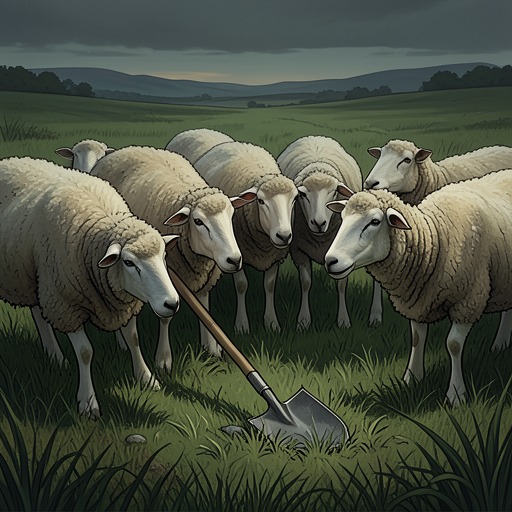
Ham arrives at the scene of George Glenn’s death among the humans running from the village. The sheep recognize him as the butcher and hate him; even the dogs are afraid of him. His approach is accompanied by a scent the flock associates with screams, pain, and blood, so that his occupation reaches them first as a threat to their own bodies. By contrast, Gabriel, walking behind Ham, inspires an inexplicable trust in the sheep. The contrast establishes Ham as a figure the flock reads through danger rather than through human explanations.
Ham’s menace becomes personal when he takes Lilly’s chin in his thick fingers and makes her look at him. He tells her that her relationship with George will invite suspicion, invokes George’s will, and warns that she should be nice to him if she wants to avoid trouble. Lilly tries to free her head and trembles after Ham lets her go. The encounter presents him as someone able to turn his physical power and knowledge of the coming investigation into pressure on another person; the sheep, watching from a distance, understand his touch as death taking hold.
Violence, Suspicion, and the Fall
Ham’s threat becomes immediate when Mopple the Whale, fleeing through the mist, collides with him. Ham emerges from the fog and launches himself at the ram, who manages to dodge him repeatedly while Ham falls into the mud. When Mopple is exhausted, Ham clenches his hands together with a gesture that suggests crushing force. Then he abruptly vanishes from Mopple’s sight, leaving the ram trembling and unable to take comfort in the grass he has been eating. The encounter makes Ham more than a distant emblem of slaughter: he is physically dangerous to the flock, and the mist turns his sudden appearance and disappearance into a frighteningly uncertain episode.
Ham later falls from the cliffs. The sheep overhear men discussing the fall and rejecting the idea that it was an accident: Ham was sure-footed, they say, and someone may have lured him there with a note scented with violet perfume. The same conversation reports that he is alive and has a reasonable chance of survival, but is unlikely to walk again; one speaker also hopes the injuries may have left him unable to remember what happened. The possibility of deliberate luring makes Ham’s own vulnerability part of the book’s web of suspicion, while the reported loss of mobility marks a sharp reversal for the imposing figure whose size and hands had made him seem nearly unstoppable.
The Body, the Will, and What Remains Unsaid
At George Glenn’s body, Ham makes a second, more enigmatic study of the death. He ignores the other people, approaches the corpse, and traces two lines in the air above it: one running from George’s head to his stomach, the other from shoulder to shoulder. The gesture is precise, but its meaning is never explained; when Gabriel calls him, Ham leaves for the village. Set beside his earlier pressure on Lilly, this silent attention to George’s body keeps Ham close to the investigation without establishing what he knows or intends.
Ham’s place in the story changes after his fall from the cliffs. At the reading of George’s will, he hears that the dead shepherd has left his fortune to the sheep so they can go to Europe, with an authorized representative appointed to accompany them and administer their care. Kate’s laughter follows the announcement, and Ham blinks hard, as though the moment’s painfulness reaches him too. The will’s provisions require more than a guide: the representative must arrange daily readings and ensure that the sheep are neither sold nor slaughtered. Ham is present as the flock’s future is made subject to a human legal process, but the terms do not give him authority over that future.
Later, Rebecca tells the sheep a story about a girl with two fathers, one secret and one not, whose estrangement from the secret father ends with his waiting for her until he dies. The tale does not name Ham or identify either father, so it cannot settle his relationship to the story’s family history. Its placement nevertheless gives his earlier hard blinking a further emotional echo: Ham’s injuries and silence leave room for feeling, while the narrative withholds a clear account of what he understands or can say. His movement from a feared, physically imposing presence to a badly injured man is thus accompanied by a narrowing of what the reader can know about him.
Perspective and Uncertainty
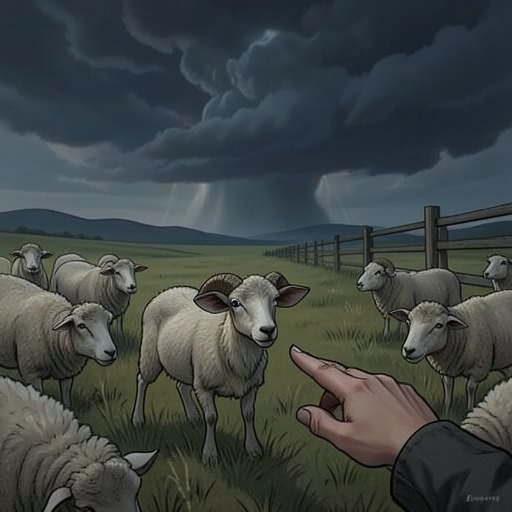
The sheep’s distance from Ham is literal as well as interpretive. Othello tries to watch both Ham and Lilly and the exchange involving Gabriel, but no sheep wants to approach either the butcher or George Glenn’s corpse, which both smell of death. Miss Maple takes over watching Ham; when the humans resume talking, the flock is too far away to hear them. Their account can register Ham’s grip on Lilly, his departure, and his silent tracing above George’s body, but it cannot supply the human conversation that might explain either action.
That restricted vantage keeps Ham’s menace distinct from proof of guilt. His warning to Lilly, his attention to the corpse, and the later report that someone may have lured him to the cliffs all make him central to the flock’s suspicions, yet none establishes what he knows about George Glenn’s death. The sheep can read the force of his hands and the danger of his presence; the motives behind them remain beyond their reach.